The Cluster Analysis Dashboard lets you explore the results by combining water availability, renewable energy potential, and hydrogen production capacity. Interactive maps, counters, and tables allow you to analyze regional suitability for hydrogen development and to filter results by cluster class.
The Cluster Analysis Dashboard includes the following indicators and features:
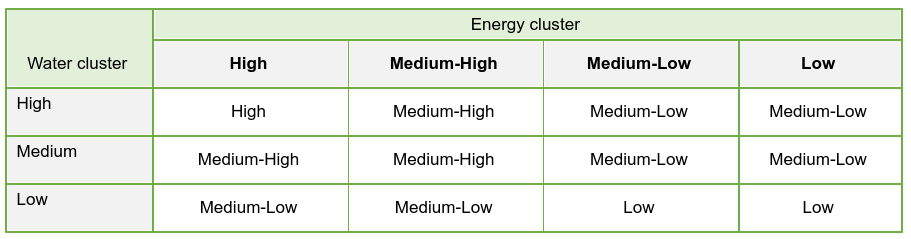
- Cluster classification [-]. Regions are grouped into four suitability clusters—High, Medium-high, Medium-low, and Low—based on the combined assessment of water availability and renewable energy production.
- Potential hydrogen production [kt H₂/year]. Planned and potential hydrogen production capacity is displayed and overlaid on the cluster map to highlight spatial patterns and regional development opportunities.
- Cluster filtering. Users can interactively filter regions by cluster class (High, Medium-high, Medium-low, Low) to focus on specific suitability levels.
- Cluster counters and tables. Numerical counters summarize the number of regions belonging to each cluster, while tabular data provide detailed regional information, including water availability, renewable energy production, and assigned cluster.
The following table represents how Energy and Water clusters have been combined to get the cluster classes. More details on Report 2.
Temporal time frames considered:
- current scenario, corresponding to the most recent period for which data are available from the selected sources.
- reference future scenario, corresponding to the SSP3-7.0 defined in the IPCC Sixth Assessment Report. It represents a “regional rivalry” pathway characterized by fragmented governance, limited international cooperation, and slow technological diffusion. Emissions remain high throughout the century, making this scenario broadly consistent with a continuation of current policy trends and close to a business-as-usual trajectory.
- pessimistic future scenario, corresponding to the SSP5-8.5 defined in the IPCC Sixth Assessment Report. It represents a fossil-fuel-driven development pathway with very high energy demand and minimal mitigation efforts, and is commonly used as a worst-case or high-end reference scenario to explore upper-bound climate risks.